When Social Media Deletes Your Account, Who Protects Your Livelihood?
Content creators, independent workers and small businesses are calling for fair warnings, clear explanations and genuine appeals when social media accounts are removed. Bonafide Xchange (BFX) has launched a global petition asking governments and major platforms to establish and enforce reasonable protections.
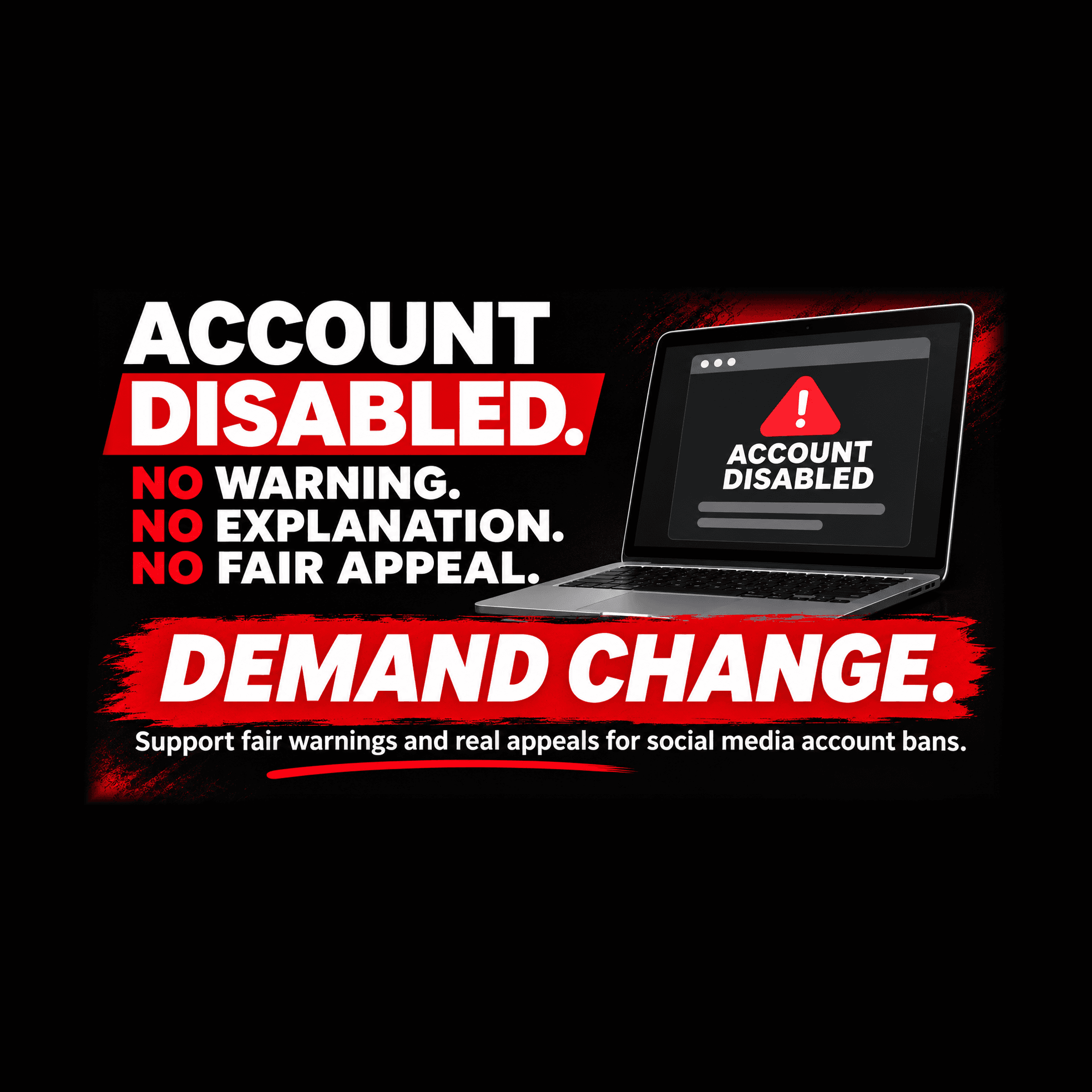
Imagine opening Instagram one morning and discovering your business account has disappeared.
Years of building an audience. Customer relationships. Photos, videos, conversations and marketing investments. Suddenly, you cannot access any of it.
You attempt to appeal, but the information you’re given doesn’t clearly explain what went wrong. You may be directed to automated processes, told that a decision is final, or left trying to work out whether something you posted breached a rule you didn’t even realise applied.
Meanwhile, your customers are wondering where you’ve gone.
And you’re wondering how you’re supposed to keep your business running.
For people whose income depends on social media, this is a serious problem.
We’re calling for change. Sign our global petition demanding fair warnings and real appeals.
Sign the Petition
When an account becomes part of your livelihood
Social media has changed how people run businesses.
Photographers use Instagram as a portfolio. Content creators build audiences that support paid subscriptions. Small businesses rely on Facebook and Instagram to communicate with customers, advertise services and attract new enquiries.
Independent companions and adult content creators also use social media to establish their professional identities, maintain communities and direct interested audiences to their websites.
Some people spend years developing these accounts. Others pay for advertising, professional photography, social media management and content production.
When an account is removed, the consequences can extend well beyond losing followers.
Customers may not know where to find the business. Existing messages can become inaccessible. Advertising campaigns may be interrupted, and years of work can be difficult to recover.
The loss of income is not always immediate or easy to calculate. That doesn’t make the disruption insignificant.
What happened to the warning?
Nobody is suggesting social media platforms should operate without rules.
Illegal content, exploitation, serious harassment and genuine safety threats require appropriate intervention. Some circumstances justify immediate account removal.
But what about an ordinary policy breach that could have been corrected?
What if a business unknowingly used a restricted word in a caption? What if a post was misunderstood by an automated moderation system? What if an account was reported maliciously?
A reasonable process should allow users to understand what happened and challenge mistakes.
For non-serious breaches, a warning and an opportunity to correct the problem should generally come before permanent removal.
When an account is disabled, the platform should identify the relevant policy and provide sufficiently specific information to make an appeal meaningful.
Simply telling someone they’ve violated community standards doesn’t necessarily tell them what they did.
How can people follow the rules when they cannot establish which rule they allegedly broke?
Adult industry workers face an additional challenge
For companions and adult content creators, the issue becomes particularly complicated.
Social media platforms have their own restrictions concerning sexual content, nudity, solicitation and advertising. Those restrictions may apply even where the underlying business operates lawfully.
Workers still need to understand what they’re permitted to publish.
A companion might use social media for everyday photographs, business updates, personal branding or networking. An adult content creator might use it to share non-explicit material and direct followers to another platform.
Neither should have to guess which piece of content triggered an enforcement decision.
The rules should be understandable, consistently applied and accompanied by a meaningful appeals process.
Adult industry workers should not be excluded from fair treatment simply because their occupation carries stigma.
And this concern isn’t limited to adult businesses. Artists, educators, influencers, retailers and ordinary account holders can also face account restrictions and disputes.
That is why this conversation needs to involve people from every industry.
We know how disruptive this can be
At Bonafide Xchange (BFX), we’ve experienced repeated social media account removals while trying to establish and grow our business.
We’ve invested time and resources building our social media presence, connecting with industry communities and introducing people to the platform.
Losing access has interrupted that work and forced us to redirect our efforts into rebuilding connections elsewhere.
The frustration isn’t simply that platforms have policies. We understand why policies exist.
It’s the difficulty of getting clear answers, understanding the decisions and finding a meaningful way to resolve disputes.
We also recognise that our experience is only one part of a much wider discussion.
We want to hear from other people who’ve faced similar problems, whether they run a business, create content or have lost access to an account containing years of personal history.
Other countries are already addressing platform accountability
The European Union’s Digital Services Act requires covered services to provide clear reasons for certain content moderation decisions, including account restrictions.[1][2] It also provides mechanisms for challenging those decisions through internal complaints and out-of-court dispute resolution.[1][2]
Australia is considering its own reforms.
In October 2026, the Australian Government introduced its Digital Duty of Care legislation, including proposals to establish minimum standards for complaint and dispute processes with platforms.[3][4]
While these proposals focus heavily on online safety, fair treatment of account holders deserves explicit attention too.[4]
These developments show that governments can establish standards for how major online services treat their users.
But protections need to be specific, accessible and enforceable.
Safety and fair treatment should be considered together.
What needs to change?
We believe social media users should be entitled to reasonable safeguards when their accounts are restricted or removed.
These should include:
- Clear explanations: Identify the specific policy allegedly breached and the content or activity responsible, wherever reasonably possible.
- Fair warnings: Allow users an opportunity to correct ordinary, non-serious breaches before permanent account removal.
- Genuine appeals: Provide accessible human reviews, reasonable response timeframes and independent escalation options.
- Access to data: Allow affected users to retrieve their content and business records wherever lawful and practicable.
- Consistent treatment: Apply transparent moderation standards to lawful businesses and individuals, including workers in industries that face stigma.
- Accountability: Require platforms to correct wrongful removals promptly and provide appropriate remedies where demonstrable harm has occurred.
These protections should include sensible exceptions where urgent action is required to prevent serious harm, protect people or comply with the law.
Platforms have a responsibility to keep their services safe. They should also be accountable for the decisions they make.
It’s time to demand fair treatment
Bonafide Xchange has launched a global petition calling for fair warnings, clear explanations and meaningful appeals when social media accounts are removed.
We’re calling on the Australian Government, governments and regulators worldwide, and major social media platforms to establish and enforce reasonable protections.
We want to bring together affected creators, independent workers, businesses, community organisations and everyday users.
Our aim is to gather support, document experiences and bring these concerns to decision-makers.
We’re also interested in whether people affected by similar removals may have grounds for collective legal action. That is a separate question requiring professional legal assessment.
For now, we want people to have a voice.
If you’ve lost a social media account without a clear explanation, struggled through an unsuccessful appeal, or watched years of work disappear, your experience deserves to be heard.
Nobody should have to lose access to their livelihood without a fair explanation and a meaningful opportunity to challenge the decision.
Fair Warning. Fair Appeal. Demand Change.
Whether you’ve personally experienced an account removal or believe platforms should be held to fairer standards, we invite you to read the petition, consider adding your signature and share it with others.
Together, we can bring greater attention to an issue affecting people and businesses around the world.
Sources
- Digital Services Act: Questions and Answers, European Commission, December 19, 2025
- Regulation (EU) 2022/2065 (Digital Services Act), EUR-Lex, October 19, 2022
- Digital Duty of Care, Australian Government
- Digital Duty of Care next step in Australia’s world-leading reforms, The Hon Anika Wells MP, Minister for Communications, October 15, 2026